

Will At&t Repair S7 Edge Cracked Screen Under Warrenty
A will or testament is a legal document that expresses a person's (testator) wishes as to how their belongings (estate) is to be distributed afterward their decease and every bit to which person (executor) is to manage the belongings until its concluding distribution. For the distribution (devolution) of property not adamant by a will, run into inheritance and intestacy.
Though it has at times been thought that a "will" historically applied but to real belongings while "attestation" applied only to personal belongings (thus giving rising to the popular title of the document as "last will and testament"), the historical records prove that the terms have been used interchangeably.[i] Thus, the give-and-take "will" validly applies to both personal and real belongings. A will may also create a testamentary trust that is constructive only after the death of the testator.
History [edit]
Throughout most of the world, disposal of an manor has been a matter of social custom. According to Plutarch, the written volition was invented by Solon.[ commendation needed ] Originally, it was a device intended solely for men who died without an heir.
The English language phrase "will and testament" is derived from a period in English law when Old English and Police force French were used next for maximum clarity. Other such legal doublets include "breaking and entering" and "peace and quiet".[2]
Freedom of disposition [edit]
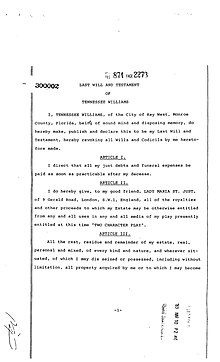
The concept of the freedom of disposition by will, familiar as it is in modernistic England and the United States, both generally considered common law systems, is by no means universal. In fact, consummate liberty is the exception rather than the rule.[three] : 654 Ceremonious police force systems oftentimes put some restrictions on the possibilities of disposal; see for example "Forced heirship".
Advocates for gays and lesbians take pointed to the inheritance rights of spouses every bit desirable for same-sex couples as well, through same-sex marriage or civil unions. Opponents of such advocacy rebut this claim by pointing to the power of same-sex couples to disperse their assets past volition. Historically, however, it was observed that "[e]ven if a same-sex activity partner executes a will, there is risk that the survivor will face prejudice in court when disgruntled heirs challenge the will",[4] with courts being more willing to strike down wills leaving property to a same-sex partner on such grounds as incapacity or undue influence.[5] [six]
Types of wills [edit]
Types of wills mostly include:
- nuncupative (not-culpatory) – oral or dictated; oft express to sailors or military personnel.
- holographic volition – written in the hand of the testator; in many jurisdictions, the signature and the material terms of the holographic volition must be in the handwriting of the testator.
- self-proved – in solemn form with affidavits of subscribing witnesses to avoid probate.
- notarial – will in public form and prepared by a civil-law notary (ceremonious-law jurisdictions and Louisiana, United States).
- mystic – sealed until death.
- serviceman'southward will – will of person in active-duty armed services service and usually lacking certain formalities, particularly under English police force.
- reciprocal/mirror/common/husband and married woman wills – wills made by two or more parties (typically spouses) that make similar or identical provisions in favor of each other.
- articulation will – like to reciprocal wills just i instrument; has a bounden upshot on the surviving testator(s). Offset documented in English police in 1769.[seven]
- unsolemn will – volition in which the executor is unnamed.
- volition in solemn form – signed by testator and witnesses.
Some jurisdictions recognize a holographic will, made out entirely in the testator's own mitt, or in some modern formulations, with material provisions in the testator'south hand. The distinctive feature of a holographic will is less that it is handwritten past the testator, and oft that it need non be witnessed. In Louisiana this blazon of testament is called an olographic testament.[8] It must be entirely written, dated, and signed in the handwriting of the testator. Although the date may announced anywhere in the testament, the testator must sign the attestation at the terminate of the testament. Any additions or corrections must as well be entirely hand written to have outcome.
In England, the formalities of wills are relaxed for soldiers who express their wishes on active service; whatever such will is known equally a serviceman's will. A minority of jurisdictions even recognize the validity of nuncupative wills (oral wills), especially for military personnel or merchant sailors. However, there are often constraints on the disposition of property if such an oral will is used.
Terminology [edit]
- Administrator – person appointed or who petitions to administer an estate in an intestate succession. The antiquated English term of administratrix was used to refer to a female person administrator just is generally no longer in standard legal usage.
- Apertura tabularum – in ancient law books, signifies the breaking open up of a last will and testament.
- Beneficiary – anyone receiving a gift or benefiting from a trust
- Bequest – testamentary gift of personal holding, traditionally other than money.
- Codicil – (1) subpoena to a volition; (2) a will that modifies or partially revokes an existing or earlier volition.
- Decedent – the deceased (U.South. term)
- Demonstrative Legacy – a souvenir of a specific sum of coin with a management that is to exist paid out of a item fund.
- Descent – succession to real property.
- Devise – testamentary gift of real belongings.
- Devisee – beneficiary of real property under a will.
- Distribution – succession to personal property.
- Executor/executrix or personal representative [PR] – person named to administer the estate, generally field of study to the supervision of the probate courtroom, in accord with the testator'due south wishes in the volition. In most cases, the testator will nominate an executor/PR in the will unless that person is unable or unwilling to serve. In some cases a literary executor may be appointed to manage a literary manor.
- Exordium clause is the showtime paragraph or sentence in a will and testament, in which the testator identifies himself or herself, states a legal domicile, and revokes any prior wills.
- Inheritor – a beneficiary in a succession, testate or intestate.
- Intestate – person who has not created a will, or who does not have a valid will at the time of decease.
- Legacy – testamentary gift of personal property, traditionally of money. Note: historically, a legacy has referred to either a gift of existent property or personal holding.
- Legatee – beneficiary of personal holding under a will, i.e., a person receiving a legacy.
- Probate – legal process of settling the manor of a deceased person.
- Residuary estate - the portion of an estate remaining after the payment of expenses and the distribution of specific bequests; this passes to the residuary legatees.
- Specific legacy (or specific bequest) – a testamentary gift of a precisely identifiable object.
- Testate – person who dies having created a will before decease.
- Testator – person who executes or signs a will; that is, the person whose will it is. The blowsy English language term of Testatrix was used to refer to a female.[9]
- Trustee – a person who has the duty under a will trust to ensure that the rights of the beneficiaries are upheld.
Requirements for creation [edit]

Whatever person over the age of majority and having "testamentary chapters" (i.e., more often than not, being of sound mind) can brand a will, with or without the aid of a lawyer.
Content of the will [edit]
Required content varies, depending on the jurisdiction, but generally includes the following:
- The testator must clearly identify themselves as the maker of the will, and that a volition is being made; this is commonly chosen "publication" of the will, and is typically satisfied by the words "final will and testament" on the confront of the certificate.
- The testator should declare that he or she revokes all previous wills and codicils. Otherwise, a subsequent will revokes before wills and codicils just to the extent to which they are inconsistent. However, if a subsequent will is completely inconsistent with an before one, the earlier will is considered completely revoked by implication.
- The testator may demonstrate that he or she has the chapters to dispose of their holding ("sound mind"), and does so freely and willingly.
- The testator must sign and date the will, unremarkably in the presence of at least two disinterested witnesses (persons who are non beneficiaries). There may be extra witnesses, these are called "supernumerary" witnesses, if there is a question as to an interested-party conflict. Some jurisdictions, notably Pennsylvania, accept long abolished any requirement for witnesses. In the United States, Louisiana requires both attestation past two witnesses as well as notarization by a notary public. Holographic wills generally require no witnesses to exist valid, but depending on the jurisdiction may need to exist proved later equally to the authenticity of the testator's signature.
- If witnesses are designated to receive property under the will they are witnesses to, this has the effect, in many jurisdictions, of either (i) disallowing them to receive nether the will, or (ii) invalidating their status every bit a witness. In a growing number of states in the United States, even so, an interested party is only an improper witness as to the clauses that benefit him or her (for case, in Illinois).
- The testator's signature must be placed at the end of the will. If this is not observed, any text following the signature will be ignored, or the unabridged volition may be invalidated if what comes afterward the signature is so material that ignoring it would defeat the testator'due south intentions.
- One or more beneficiaries (devisees, legatees) must generally exist conspicuously stated in the text, but some jurisdictions allow a valid will that merely revokes a previous will, revokes a disposition in a previous will, or names an executor.
A volition may non include a requirement that an heir commit an illegal, immoral, or other human action confronting public policy equally a condition of receipt.
In community property jurisdictions, a will cannot be used to disinherit a surviving spouse, who is entitled to at to the lowest degree a portion of the testator'due south estate. In the Us, children may be disinherited past a parent'due south will, except in Louisiana, where a minimum share is guaranteed to surviving children except in specifically enumerated circumstances.[10] Many civil law countries follow a like rule. In England and Wales from 1933 to 1975, a will could disinherit a spouse; however, since the Inheritance (Provision for Family and Dependants) Human activity 1975 such an attempt tin be defeated by a courtroom guild if information technology leaves the surviving spouse (or other entitled dependent) without "reasonable fiscal provision".
Part of lawyers [edit]
At that place is no legal requirement that a will be drawn upwardly by a lawyer, and some people may resist hiring a lawyer to typhoon a volition.[11] People may draft a will with the assistance of a lawyer, use a software product[12] or will form, or write their wishes entirely on their own. Some lawyers offering educational classes for people who want to write their own will.[13]
When obtained from a lawyer, a volition may come as function of an estate planning package that includes other instruments, such as a living trust.[14] A will that is drafted past a lawyer should avoid possible technical mistakes that a layperson might make that could potentially invalidate role or all of a will.[15] While wills prepared by a lawyer may seem similar to each other, lawyers can customize the language of wills to meet the needs of specific clients.[16]
International wills [edit]
In 1973 an international convention, the Convention providing a Uniform Law on the Form of an International Will,[17] was concluded in the context of UNIDROIT. The Convention provided for a universally recognised lawmaking of rules under which a volition made anywhere, by whatever person of any nationality, would be valid and enforceable in every state that became a political party to the Convention. These are known as "international wills". It is in force in Commonwealth of australia, Belgium, Bosnia-Herzegovina, Canada (in nine provinces, not Quebec), Croatia, Cyprus, Ecuador, France, Italia, Libya, Niger, Portugal and Slovenia. Vatican city, Iran, Laos, the Russian Federation, Sierra Leone, the United Kingdom, and the Us have signed but not ratified.[18] International wills are merely valid where the convention applies. Although the U.S. has not ratified on behalf of any state, the Compatible law has been enacted in 23 states and the District of Columbia.[xviii]
For individuals who own assets in multiple countries and at least ane of those countries are non a part of the Convention, it may be appropriate for the person to have multiple wills, i for each state.[xviii] [19] In some nations, multiple wills may be useful to reduce or avert taxes upon the estate and its assets.[20] Care must be taken to avoid accidental revocation of prior wills, conflicts between the wills, to anticipate jurisdictional and choice of law bug that may arise during probate.[19]
Revocation [edit]
Methods and effect [edit]
Intentional concrete destruction of a volition by the testator will revoke information technology, through deliberately called-for or tearing the physical document itself, or by striking out the signature. In most jurisdictions, partial revocation is allowed if only role of the text or a detail provision is crossed out. Other jurisdictions will either ignore the attempt or hold that the unabridged will was actually revoked. A testator may as well be able to revoke by the physical act of another (as would exist necessary if he or she is physically incapacitated), if this is done in their presence and in the presence of witnesses. Some jurisdictions may presume that a volition has been destroyed if it had been concluding seen in the possession of the testator merely is establish mutilated or cannot be plant afterwards their expiry.
A will may as well exist revoked past the execution of a new will. Nigh wills contain stock language that expressly revokes any wills that came before them, considering otherwise a court will normally still attempt to read the wills together to the extent they are consequent.
In some jurisdictions, the complete revocation of a will automatically revives the next-most contempo will, while others concord that revocation leaves the testator with no will, so that their heirs volition instead inherit past intestate succession.
In England and Wales, matrimony volition automatically revoke a volition, for it is presumed that upon marriage a testator will desire to review the will. A argument in a will that it is made in contemplation of forthcoming marriage to a named person will override this.
Divorce, conversely, will not revoke a will, but in many jurisdictions will take the effect that the former spouse is treated every bit if they had died before the testator and then will non benefit.
Where a will has been accidentally destroyed, on evidence that this is the instance, a copy will or draft will may exist admitted to probate.
Dependent relative revocation [edit]
Many jurisdictions exercise an equitable doctrine known every bit "dependent relative revocation" ("DRR"). Nether this doctrine, courts may condone a revocation that was based on a error of police force on the part of the testator as to the event of the revocation. For example, if a testator mistakenly believes that an earlier will can be revived by the revocation of a later volition, the courtroom will ignore the after revocation if the later volition comes closer to fulfilling the testator's intent than not having a will at all. The doctrine also applies when a testator executes a 2nd, or new will and revokes their sometime will nether the (mistaken) belief that the new will would be valid. However, if for some reason the new will is not valid, a court may apply the doctrine to reinstate and probate the old will, if the court holds that the testator would prefer the quondam will to intestate succession.
Before applying the doctrine, courts may require (with rare exceptions) that there have been an alternative programme of disposition of the property. That is, afterward revoking the prior volition, the testator could have made an alternative programme of disposition. Such a programme would show that the testator intended the revocation to issue in the belongings going elsewhere, rather than just being a revoked disposition. Secondly, courts crave either that the testator have recited their fault in the terms of the revoking instrument, or that the fault be established past clear and convincing evidence. For example, when the testator made the original revocation, he must have erroneously noted that he was revoking the souvenir "considering the intended recipient has died" or "because I will enact a new will tomorrow".
DRR may exist applied to restore a gift erroneously struck from a volition if the intent of the testator was to enlarge that gift, but volition not apply to restore such a souvenir if the intent of the testator was to revoke the gift in favor of another person. For instance, suppose Tom has a volition that bequeaths $5,000 to his secretary, Alice Johnson. If Tom crosses out that clause and writes "$7,000 to Alice Johnson" in the margin, merely does non sign or date the writing in the margin, virtually states would find that Tom had revoked the earlier provision, merely had non effectively amended his will to add the 2nd; however, nether DRR the revocation would be undone because Tom was acting under the mistaken conventionalities that he could increase the gift to $7,000 past writing that in the margin. Therefore, Alice volition get 5,000 dollars. All the same, the doctrine of relative revocation will not apply if the interlineation decreases the amount of the gift from the original provision (east.thousand., "$five,000 to Alice Johnson" is crossed out and replaced with "$3,000 to Alice Johnson" without Testator's signature or the appointment in the margin; DRR does not apply and Alice Johnson will take nothing).
Similarly, if Tom crosses out that clause and writes in the margin "$5,000 to Betty Smith" without signing or dating the writing, the gift to Alice will be effectively revoked. In this example, it will not exist restored under the doctrine of DRR because fifty-fifty though Tom was mistaken about the effectiveness of the gift to Betty, that mistake does not affect Tom's intent to revoke the gift to Alice. Considering the gift to Betty volition be invalid for lack of proper execution, that $5,000 volition go to Tom's residuary estate.
Election against the will [edit]
Also referred to every bit "electing to take against the will". In the United states of america, many states have probate statutes that let the surviving spouse of the decedent to cull to receive a item share of deceased spouse'due south estate in lieu of receiving the specified share left to him or her nether the deceased spouse'southward will. As a elementary example, under Iowa constabulary (run into Code of Iowa Department 633.238 (2005)), the deceased spouse leaves a will which expressly devises the marital home to someone other than the surviving spouse. The surviving spouse may elect, reverse to the intent of the will, to live in the domicile for the remainder of his/her lifetime. This is called a "life estate" and terminates immediately upon the surviving spouse's decease.
The historical and social policy purposes of such statutes are to assure that the surviving spouse receives a statutorily set minimum amount of holding from the decedent. Historically, these statutes were enacted to preclude the deceased spouse from leaving the survivor destitute, thereby shifting the brunt of intendance to the social welfare organization.
In New York, a surviving spouse is entitled to i-third of her deceased spouse's estate. The decedent's debts, authoritative expenses and reasonable funeral expenses are paid prior to the adding of the spousal elective share. The constituent share is calculated through the "net estate". The net estate is inclusive of property that passed by the laws of intestacy, testamentary holding, and testamentary substitutes, equally enumerated in EPTL 5-1.1-A. New York'due south classification of testamentary substitutes that are included in the net estate arrive challenging for a deceased spouse to bereave their surviving spouse.
Notable wills [edit]
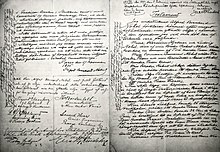
In antiquity, Julius Caesar's will, which named his grand-nephew Octavian as his adopted son and heir, funded and legitimized Octavian's ascension to political power in the tardily Republic; information technology provided him the resource necessary to win the civil wars confronting the "Liberators" and Antony and to establish the Roman Empire under the name Augustus. Antony's officiating at the public reading of the will led to a anarchism and moved public opinion against Caesar's assassins. Octavian's illegal publication of Antony'due south sealed will was an of import factor in removing his support within Rome, as it described his wish to be buried in Alexandria abreast the Egyptian queen Cleopatra.
In the modern era, the Thellusson five Woodford volition case led to British legislation confronting the accumulation of money for afterwards distribution and was fictionalized as Jarndyce and Jarndyce in Charles Dickens's Bleak Business firm. The Nobel Prizes were established past Alfred Nobel'southward volition. Charles Vance Millar'due south will provoked the Not bad Stork Derby, as he successfully ancestral the bulk of his manor to the Toronto-surface area adult female who had the greatest number of children in the ten years subsequently his expiry. (The prize was divided among four women who had nine, with smaller payments fabricated to women who had borne 10 children just lost some to miscarriage. Another woman who bore ten children was disqualified, for several were illegitimate.)
The longest known legal will is that of Englishwoman Frederica Evelyn Stilwell Cook. Probated in 1925, it was 1,066 pages, and had to exist bound in four volumes; her estate was worth $100,000. The shortest known legal wills are those of Bimla Rishi of Delhi, Republic of india ("all to son") and Karl Tausch of Hesse, Deutschland, ("all to wife") both containing only two words in the language they were written in (Hindi and Czech, respectively).[21] The shortest will is of Shripad Krishnarao Vaidya of Nagpur, Maharashtra, consisting of 5 letters ("HEIR'South").[22] [23]
An unusual holographic will, accepted into probate equally a valid one, came out of a tragic accident. On 8 June 1948 in Saskatchewan, Canada, a farmer named Cecil George Harris became trapped under his own tractor. Thinking he would not survive (though found alive subsequently, he died of his injuries in hospital), Harris carved a will into the tractor's fender, which read:
In case I die in this mess I exit all to the wife. Cecil Geo. Harris.
The fender was probated and stood as his volition. The fender is currently on display at the constabulary library of the Academy of Saskatchewan College of Police.[24]
Probate [edit]
After the testator has died, an application for probate may be made in a courtroom with probate jurisdiction to make up one's mind the validity of the will or wills that the testator may have created, i.e., which will satisfy the legal requirements, and to engage an executor. In most cases, during probate, at to the lowest degree ane witness is called upon to testify or sign a "proof of witness" affirmation. In some jurisdictions, still, statutes may provide requirements for a "cocky-proving" will (must exist met during the execution of the volition), in which example witness testimony may be forgone during probate. Often there is a time limit, commonly xxx days, inside which a will must be admitted to probate. In some jurisdictions, merely an original will may be admitted to probate—even the most accurate photocopy will non suffice.[ citation needed ] Some jurisdictions will admit a copy of a will if the original was lost or accidentally destroyed and the validity of the copy can be proved to the satisfaction of the court.[25]
If the will is ruled invalid in probate, and so inheritance will occur under the laws of intestacy every bit if a will were never drafted.
See besides [edit]
- Ademption
- Apertura tabularum
- Death and the Net, including password vaults
- Manor planning
- Upstanding will
- Forced heirship
- Inheritance
- Legal history of wills
- Trust police
- Henson trust
- Totten trust
- Will Aid
- Will contest
References [edit]
- ^ Wills, Trusts, and Estates (Aspen, 7th Ed., 2005)
- ^ Freedman, Adam (2013). The party of the first part the curious world of legalese. New York: Henry Holt and Company. ISBN978-1466822573.
- ^ One or more of the preceding sentences incorporates text from a publication at present in the public domain:Chisholm, Hugh, ed. (1911). "Will". Encyclopædia Britannica. Vol. 28 (11th ed.). Cambridge Academy Press. pp. 654–658.
- ^ Eugene F. Scoles, Issues and Materials on Decedents' Estates and Trusts (2000), p. 39.
- ^ Chuck Stewart, Homosexuality and the Police force: A Dictionary (2001), p. 310.
- ^ Run into too, for case, In Re Kaufmann's Will, xx A.D.2nd 464, 247 N.Y.S.2nd 664 (1964), aff'd, 15 N.Y.2d 825, 257 North.Y.S.2d 941, 205 N.E.2d 864 (1965).
- ^ Repository Citation: Contracts Not to Revoke Joint or Mutual Wills, 15 William & Mary Law Review 144 (1973), https://scholarship.law.wm.edu/wmlr/vol15/iss1/7
- ^ Louisiana Ceremonious Code Article 1575 http://legis.la.gov/lss/lss.asp?doc=108900/
- ^ "Definition of TESTATRIX".
- ^ For example, if the child attempted to kill the parent.
- ^ "Steps to Create an Estate Plan - Consumer Reports". Consumer Reports. Nov 2022. Retrieved 2020-04-21 .
- ^ Hartman, Rachel (2019-xi-06). "The All-time Online Will Making Programs". United states of america News & Globe Report.
- ^ Ewoldt, John (2016-05-eleven). "Prince'southward estate highlights the value of creating a volition". Minneapolis Star Tribune. Archived from the original on 2022-05-11. Retrieved 2020-04-21 .
- ^ Sullivan, Paul (2018-09-07). "Making Wills Easier and Cheaper With Practice-It-Yourself Options". The New York Times. ISSN 0362-4331. Retrieved 2020-04-21 .
- ^ Beck, Laura W.; Bartlett, Stefania Fifty.; Nerney, Andrew M. "Wills: Connecticut" (PDF). Cummings & Lockwood, LLC. Practical Law. Retrieved 23 April 2022.
- ^ Hill, Catey (2015-eleven-27). "Don't buy legal documents online without reading this story". Marketplace Watch . Retrieved 2020-04-21 .
- ^ "Convention providing a Compatible Law on the Course of an International Volition (Washington, D.C., 1973)". world wide web.unidroit.org. 2022-11-07. Retrieved 2020-02-22 .
- ^ a b c Eskin, Vicki; Driscoll, Bryan. "Manor Planning with Foreign Property". American BAR Clan. Retrieved three January 2022.
- ^ a b Fry, Barry (2012). "Cantankerous Border Estate Issues" (PDF). Advoc . Retrieved vii June 2022.
- ^ Popovic-Montag, Suzana; Hull, Ian Thou. (2 October 2022). "The Risks and Rewards of Multiple Wills". HuffPost Canada Business concern . Retrieved 7 June 2022.
- ^ "Thelongestlistofthelongeststuffatthelongestdomainnameatlonglast.com". thelongestlistofthelongeststuffatthelongestdomainnameatlonglast.com.
- ^ TARUN BHARAT (www.tarunbharat.internet) Nagpur, Saturday, 28 April 2022
- ^ PUNNYA NAGARI (Marāthi language daily published at Nagpur) Friday 8 June 2022
- ^ On Campus News, January 23, 2009: The Terminal Volition and Testament of Cecil George Harris
- ^ "NRS: Affiliate 136 - PROBATE OF WILLS AND PETITIONS FOR Messages". www.leg.state.nv.us.

Books [edit]
- Administration of Wills, Trusts, and Estates by Gordon Due west. Dark-brown, Delmar Cengage Learning (ISBN 978-0-7668-5281-five)
External links [edit]
 | Wikiquote has quotations related to: Wills |
 | Wikimedia Commons has media related to Wills. |
- Citizens Advice Bureau (United kingdom)
- Prerogative Court of Canterbury wills (1384–1858) at the National Archives (pay per view)
- Prerogative Court of Canterbury wills on Beginnings.co.united kingdom (subscription)
- Download the wills of famous people (UK National Archives)
- William Shakespeare'south Will
- Thomas Jefferson'due south Terminal Will
- Jane Austen'due south Will

Will At&t Repair S7 Edge Cracked Screen Under Warrenty,
Source: https://en.wikipedia.org/wiki/Will_and_testament
Posted by: johnstoncates1991.blogspot.com
0 Response to "Will At&t Repair S7 Edge Cracked Screen Under Warrenty"
Post a Comment